
Canada’s New Immigration Reality: Fewer Pathways, Greater Risks in the 2026 Levels Plan

Each year, the federal budget and Canada’s Immigration Levels Plan set the tone for how the immigration system will function in practice. The budget determines how much funding IRCC receives to manage applications, expand digital tools, and support program delivery. The Levels Plan outlines how many immigrants Canada intends to admit across economic, family, humanitarian, and temporary resident categories. When read together, these two documents reveal the government’s priorities, the pressure points applicants may face, and where new opportunities are likely to emerge in the months ahead.
After months of signals leading up to the 2025 Budget and the 2026 Immigration Levels Plan, we now have a direction, and it’s unlikely to satisfy any stakeholder. From international students to employers facing ongoing labour shortages, the Levels Plan will significantly influence Canada’s economy, our ability to stock grocery stores and pantries, and the stability of our healthcare system.
Permanent resident admissions will remain at 380,000 per year, with 64% allocated to economic immigration streams, including Express Entry, the Provincial Nominee Programs, and pilots such as the Rural Community Immigration Pilot.
Family reunification will represent just over 22% of admissions, encompassing spouses, dependent and adopted children, and parents and grandparents.
Humanitarian and refugee pathways—including government-assisted and privately sponsored refugees, protected persons, Humanitarian and Compassionate cases, and special programs for individuals affected by crises—will account for slightly more than 14%.
French-speaking immigration is projected to represent 9% of admissions in 2026, increasing to 10.5% by 2028.
Temporary resident admissions will also see a significant shift. The number of temporary workers is slated to drop sharply from approximately 674,000 to 385,000 in 2026. Within this category, the majority admitted will fall under the International Mobility Program and international students, with temporary foreign workers representing the smallest share of approvals.
Economic Immigration
Economic immigrants are selected for their education, skills, and experience, with the expectation that they will fill roles in higher-skilled sectors. In practice, however, many foreign-trained professionals continue to face barriers, particularly around credential recognition and access to roles that match their qualifications. While the budget includes a measure aimed at improving credential recognition, it lacks meaningful detail on implementation or timelines.
The plan also includes a commitment to recruit up to 1,000 international researchers through Canada Research Chairs and to facilitate the relocation of doctoral and post-doctoral fellows and international assistant professors. Although these pathways are positioned as new levers to strengthen Canada’s research ecosystem, they are largely redundant as these options already exist. Universities have long been able to recruit internationally, as specialized research fields often span borders and talent mobility is well-established. It is unclear how reserving 1,000 spaces meaningfully shifts outcomes, and the measure risks signaling insufficient support for Canadian PhD graduates and early-career academics already in the system.
A more consequential development may be the accelerated pathway for H-1B holders currently working in the United States. These are highly skilled professionals in specialized fields, and the recent imposition of a USD $100,000 employer fee for new H-1B applications in the U.S. may reduce the program’s attractiveness there. No separate quota has been assigned to this stream, suggesting it could fall within the broader economic category with targeted processing measures. If effectively implemented, this initiative could position Canada to attract specialized talent currently in the U.S. labour market.
However, retention remains a concern. H-1B professionals typically earn significantly higher salaries in the U.S. than in Canada, and 2023 initiatives saw beneficiaries obtain permanent residence in Canada only to return south through opportunities open to Canadian permanent residents. While the geopolitical and policy environment in the U.S. has shifted, it remains uncertain whether these measures will result in long-term gains for Canada’s labour market, or primarily short-term inflows.
The bright spot in this category is the increased allotment to the Provincial Nominee Programs. The provinces usually have a better handle on their labour needs than Ottawa does and are better positioned to respond quickly to changing needs. For those eying permanent resident pathways, the provinces should be on your radar.
Family Reunification
Family reunification remains a core pillar of Canada’s immigration system. Yet those seeking to bring loved ones to Canada, including Canadian citizens sponsoring spouses or dependent children, are likely to encounter longer processing times rather than expanded pathways. Increased scrutiny of spousal sponsorship applications can also be expected, with applications missing key documentation or raising credibility concerns facing a higher risk of refusal.
While refusals can be appealed, the most effective approach is to mitigate risk at the outset. Thorough, well-documented submissions that clearly address eligibility criteria and evidentiary requirements will be essential to navigating this environment successfully.
Those hoping to sponsor parents or grandparents will be disappointed. While they are still accounted for in the levels plan, 15,000 spots will fill quickly after years of pent up demand.
Humanitarian Programs
Whether you are a Canadian citizen or permanent resident seeking to support refugees abroad or hoping to help relatives leave dangerous circumstances, the new levels plan will make these pathways more constrained. Demand significantly exceeds the number of applications that will be approved each year, resulting in longer processing times, heightened scrutiny, and probably temporary pauses to several programs. Applicants should anticipate delays and prepare for a more rigorous review environment.
French
One clear area of growth within the plan is French-language admissions. In 2026, IRCC aims for 9% of permanent residents settling outside Québec to be French speaking, rising to 10.5% by 2028. For prospective applicants, strong French-language skills, at least NCLC 7, continue to offer a meaningful advantage. For many, French may be the differentiating factor in securing an invitation to apply, and its importance within the system is unlikely to diminish in the foreseeable future.
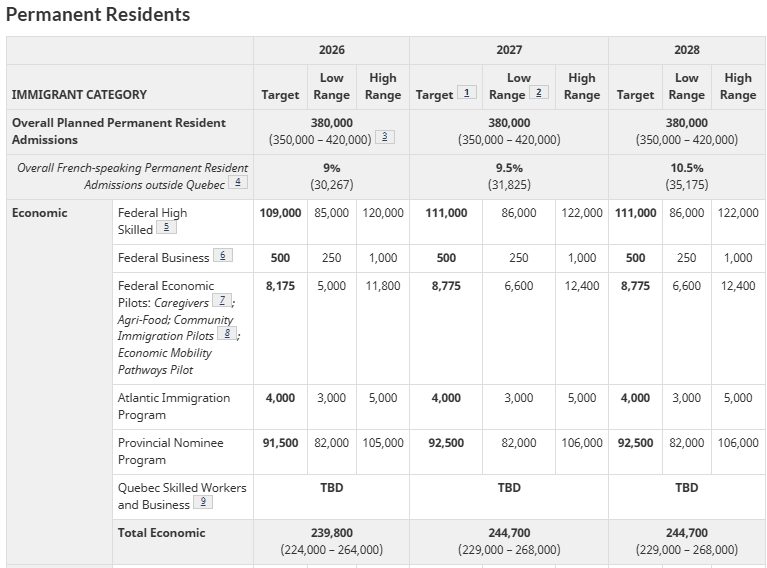
The 2026 Levels Plan by the Numbers - Permanent Residence
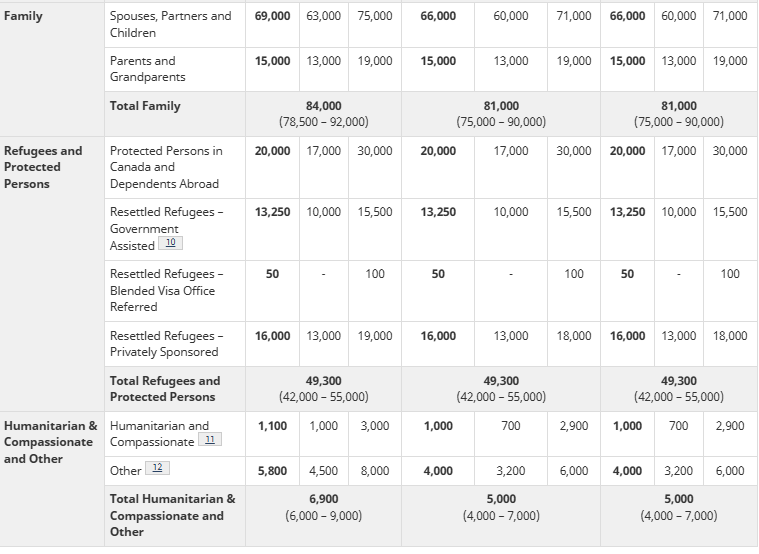
The 2026 Levels Plan by the Numbers - Permanent Residence
The numbers in bold text identify the targets for each immigration category, while the low and high range allow for adjustments up and down according to changing priorities and demand.
Temporary Workers
Temporary resident pathways form a broad category serving multiple policy and labour objectives. They include:
Labour Market Impact Assessment (LMIA)–based work permits, typically tied to specific employer needs
International Mobility Program (IMP) permits, driven by trade agreements, reciprocal arrangements, and broader Canadian interests
Post-Graduate Work Permits (PGWPs) for international students completing eligible programs
Open work permits issued under select public policies, most commonly to spouses of foreign workers and international students
Together, these temporary pathways will be capped at 230,000 in 2026, with a further reduction to 220,000 by 2028.
To understand the implications for Canada’s economy, it is necessary to consider which sectors rely most heavily on temporary labour. LMIA-supported positions are concentrated in lower-wage, labour-intensive industries, including agriculture and food processing, hospitality, and segments of healthcare. These permits will be capped at 60,000 in 2026 and 50,000 thereafter, raising concerns about workforce shortages in essential services. Canadians may experience impacts through disruptions in agricultural supply chains, increased service-sector costs, and continued staffing constraints in healthcare settings.
The IMP allocation (170,000 permits from 2026 to 2028) reflects a continued focus on attracting higher-skilled talent through corporate transfers and trade-agreement pathways. PGWPs, which fall under the IMP, remain available to eligible graduates from designated institutions, though within tighter overall limits.
Open work permits, issued primarily to spouses of international students and foreign workers, will continue under defined streams, though also constrained by the broader cap.
Taken together, these measures represent a shift toward prioritizing higher-skilled temporary workers while constraining essential-sector labour supply with downstream implications for affordability, service delivery, and economic stability in key industries.
International Students
Alongside temporary foreign workers, international students are among the most affected by the new immigration levels. Study permit approvals will drop from 305,900 in 2025—a target that had reached only 85,000 approvals by August of that year—to 155,000 in 2026, with a further reduction to 150,000 by 2028.
Students pursuing university-level degrees, whether at the undergraduate or graduate level, may have comparatively higher approval prospects, provided their program selection aligns clearly with their academic history and career trajectory. Applicants pursuing college-level credentials may face greater difficulty, particularly if the program is not their first post-secondary qualification.
In this environment, careful planning and the submission of comprehensive, well-supported study permit applications and study plans will be essential. Strong alignment between academic goals, professional background, and long-term plans will be critical to success.
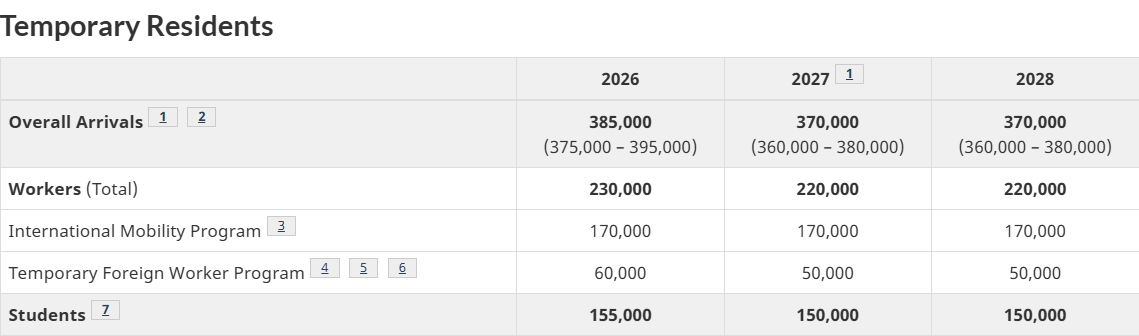
The 2026 Levels Plan by the Numbers - Temporary Residents
Unclear categories and purposes
The plan also references an intention to transition 33,000 temporary residents to permanent status, but the absence of program details or eligibility criteria makes it too early to assess, or place much confidence in, this commitment.
Similarly, the government has indicated plans to admit 115,000 protected persons who are eligible for permanent residence. Protected persons are individuals who have received positive decisions on inland refugee claims and, in most cases, are already entitled to apply for permanent residence. It is unclear why this is being framed as a new measure or which applicants stand to benefit. One possibility is that this allocation will help move approved claimants more quickly through the backlog, which currently suggests processing times exceeding eight years. However, without further clarity, the operational impact remains uncertain.
Whatever the method or purpose, these additional 74,000 permanent residents increase the final numbers for 2026 and 2027 to 454,000.
Key Takeaways and What You Can Do in Your Immigration Journey
For those already in Canada, pathways remain, so long as you maintain valid status and keep documents up to date. Processing may slow, but IRCC appears inclined to retain some temporary residents who are already contributing.
For those outside Canada, opportunities will be limited for the next three years unless you fit into a targeted program aimed at attracting talent from the U.S.
If delays persist, only the highest CRS profiles move forward, and Ottawa can’t figure out how to retain the H1-B visa holders once they obtain permanent residence, immigrants may leave for countries that offer clearer routes to permanence. In that case, Canada risks losing more talent in the next 3–5 years than it hopes to gain by restricting intake.
With few immigration categories eligible for IRB appeal, the Federal Court will remain the primary recourse for those who can afford to litigate. For others, these changes may effectively close the door on their Canadian plans.
What I suggest, as a Regulated Immigration Consultant, is to:
Know the immigration pathways available to you, based on your skills and experience, and the process associated with each route
Understand the eligibility requirements and how to fulfill them with evidence
Speak with a licensed professional who understands this field, and can guide you toward the best immigration options for your situation.
At Compass Immigration Solutions we know every immigration journey is different, and we’re here to help you navigate yours. We take the time to listen, offer the right advice and services, and develop a plan based on your specific needs.